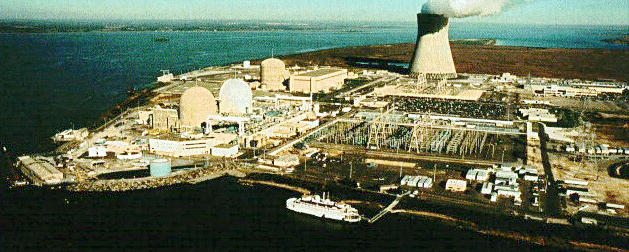
A view of the Hope Creek nuclear power plant near Hancocks
Bridge, New Jersey. Salem, in the foreground, has 2
Westinghouse 4 Loop PWR units. In the background is the
single General Electric BWR-4 Hope Creek unit.
A view of the Hope Creek nuclear power plant near Hancocks
Bridge, New Jersey. Salem, in the foreground, has 2
Westinghouse 4 Loop PWR units. In the background is the
single General Electric BWR-4 Hope Creek unit.
The content below of this webpage was written in July 2000 (and it has been left unchanged) following the failure to conduct the
World Congress on Recycling Nuclear Waste in both the U.S.A. and Europe because of obstructions by responsible governmental offices in both countries so incredible that cannot be reported here for fear of losing credibility. We merely leave the reader with the evidence that such an important conference could not be conducted in both the U.S.A. and Europe despite the world caliber of the organizers and documented repeated attempts. The announcement has been left in the website of the Institute for Basic Research (IBR) as a memento for these incredible occurrences.
The evident reason for said obstructions was the primary objective of the meeting, that of gathering the best scientific minds in the world to initiate in depth mathematical, theoretical, experimental and industrial studies on the recycling of nuclear waste via its stimulated decay in the pools of nuclear power plants. The main argument is that, since the nuclei here referred to are very large and naturally uinstable, it is quite plausible to expect the existence of various mechanisms that would stimulate their decay, from meanlives of thousands of years down to practically valuable meanlife of the order of seconds, miniutes or days, depending on the case. In fact, several mechanisms have been identified, and some of them even patented, by their authors have received life threats and had top abandn their studies. This web site is dedicated to the privately funded research in the field by the the Italian-American scientist Prof. Ruggero Maria Santilli (Curriculum).
The origin of life threaths is that the stimulated decay of nuclear waste would avoid the transportation and storage of nuclear waste in the Jukka Mountain and other depositories. The evident problem is that such a solution would prevent the dispersal of billions of dollars in taxpayers money by the US and European governments, with evident loss by governmental officers and their affiliated corporations of notorious gains resulting from the dispersal of billions of dollars in public funds.
Due to threats received by researchers in nuclear waste recycling not aligned with governmental regimes in the U.S.A. and Europe, Prof. Santilli and all members of the IBR have abandoned all research in the field in the year 2000 with the commitment never to resume them again. To olur knowledge, the action by institutionalized cartels so clearly against the interest of society has been so effective, that no serious research has been done in the field, except for orchestrated work intended to provide the perception of serisous research in the field, while studiously avoiding the addressing of the main issues.
A number of courageous authoritative condemnations of clear governmental oppositions to basic societal needs for personal gains by governmental officers and their affiliates, have been voiced around the world. We here indicate the book and references quoted therein Exploding a Myth, by Prof. J. Dunning-Davies,, University of Hull, England, Horwood Publishing (2007).
Nevertheless, out a sense of social duty, we would like to indicate for interested scientists and observers the following main advances occurrence since the year 2000, because potentially relevant for the recycling of nuclear waste by the nuclear power plants themselves in their own pools. The hope is that, perhaps, one day, society will understand the necessity of preventing the political control of science by governmental, corporate and academic complex, and only thereafter be in a position of seriously addressing major environmental problems, such as the recycling of nuclear waste.
The most salient scientific event in the field known to us since the year 2000, has been the completion of systematic mathematical, theoretical and experimental studies by Prof. Santilli on the structure of the neutron and its synthesis from a proton and an electron as occurring in stars.
A comprehensive review of these studies is now available in the website under construction
The R. M. Santilli Foundation
that contains original scientific works in free pdf downloads (when copyrighted), including most of the literature quoted at the end of this website.
The technical presentation of the studies is available in five volumes recently written by Prof. Santilli and available as free download from the website
Hadronic Mathematics, Mechanics and Chemistry, Volumes I, II, III, IV and V
A short review of these studies, readable by the general, well educated public, is that by Prof. J. Kadeisvili available in the website
The Rutherford-Santilli neutron
Prof. Santilli's has conducted extensive experimental verifications on the laboratory the synthesis of neutrons from protons and electrons via electric arcs within a hydrogen gas. This experimental work is available in free pdf download from the website
http://www.i-b-r.org/NeutronSynthesis.pdf.
Pictures and scans of the tests available from the web site
http://www.neutronstructure.org/neutron-synthesis.htm
Hoping not to receive additional threats, Prof. Santilli has applied the results of the fundamental synthesis of the neutron to nuclear syntheses under his novel, industrially funded, Intermediate Controlled Nuclear Fusions, called intermediate because occurring at threshold energies intermediate between those of the failed "cold" and "hot" fusions, and controlled because nuclear fusions are truly controlled via the control of power, pressure, currents, temperature, polarizations, riggers, and other means. A report dated early 2008 is available in free pdf download from the website Intermediate Controleld Nuclear Fusion.
As one can see, the industrial (and certainly not governmental-academic) funding is devoted to the synthesis of nitrogen from carbon and two hydrogen atoms via the intermediate synthesis of the neutron. The mechanism is that ofh electric arcs patterned along the nitrogen synthesis expected in lighting. A point important for society is that the synthesis of the nitrogen can occur if and only there there is NO release of neutrons or other massive radiations, because of unavailable energies at threshold, absence of instabilities and other reasons. Hence, Santilli's synthesis of nitrogen is truly clean because it does not release harmful radiations, and it does not leave radioactive waste (since it turns light, stable natural elements into light, stable, natural elements).
As well documented, Prof. Santilli (a theoretician) requested for some thirty years to all major physics laboratories around the world to test the most fundamental synthesis in nature, that of neutrons from protons and electrons as occurring stars, because evidently necessary for any serious study of subsequent nuclear syntheses as currently attempted with the "cold" and "hot" fusions.
As equally documented, Prof. Santilli received in return "discrdeditations" for just proposing the test, because known to be contrary to Einsteinian and quantum doctrines (see the above quoted literature for the technical reasons). Hence, in 2006 he decides to conduct the tests himself at the IBR laboratory in Florida with the assistance of the Institute technicians Terry Allen, John T. Judy, Eugene West, Ray Jones and Jim Allen. Following over one year of running the tests, the collaboration of three U. S. companies supplying various neutron detectors, and numerous verifications (including the evacuation of the laboratory twice because of excessive sonic and vibrational alarms by all neutron counters), the tests were indeed successful, as reported in the above quoted experimental paper and related web site.
Subsequently, Prof. Santilli has contacted again various physics laboratories around the world requesting, this time, to verify or deny the results achieved by his group, again, due to their transparent fundamental relevance and their very limited cost (a hydrogen chamber traversed by a DC arc), which cost is lilliputian compared to the extremely costs of other experiments preferred by academia these days, even too of immensely smaller scientific relevance and no value whatsoever for society.
Again, rather than collaborating, all contacted physics conduits disqualified Prof. Santilli's work on ground that it is "fringe science" (Wikipedia), "fraudulent," and the like, under the full knowledge, particularly by qualified academicians, that experimental results can only be dismissed with counter-experiments, and absolutely not via theoretical theologies proffered in dirty academic corridors.
According to qualified informers whose names cannot be disclosed here to prevent their lives from being disrupted, at least two physics laboratories have repeated Prof. Santilli synthesis of the neutron, but have received orders not to disclose the results. It is evident that, had these departments achieved negative results, they would have propagated the dismissal of Prof. Santilli's neutron synthesis all over the scientific world. Since the results of the reruns are positive, they cannot be released because establishing incontrovertible limits of applicability of Einsteinian and quantum doctrines, not for conditions they were conbceived for (atomic structure), but for confidtions beyond those of their original conception.
At any rate, Einsteinian and quantum doctrines are fully reversible over time because reflecting the time invariance of the systems intended to be described, electron orbits around nuclei that are indeed time reversal invariant, in which case Einsteinian doctrines and quantum mechanics are indeed exactly valid. However, whether stimulated or natural, nuclear waste decays, as well as all energy releasing processes, are manifestly irreversible over time (their time reversal image violates causality). Therefore, any belief that the time reversal invariant, Einsteinian and quantum doctrines are exactly valid for irreversible processes, such as nuclear waste decays, is clear scientific corruption because the selection of the appropriate generalization of Einsteinian and quantum theories should indeed be subject to scientific debates, but not their need.
Due to the above unreassuring condition of academic "pseudo-science" popularly perceived as being "serious science," and in view of past threats, Prof. Santilli elected NOT to conduct the last and most important test for nuclear waste recycling, the stimulated decay of the neutron via resonating photons and other triggers, and no plan for such a test exists at the IBR to our knowledge at this time.
It is time for society to wake up, admit the incontrovertible collapse of scientific ethics in governments and academia alike, prevent the control of science by political regimes, and only thereafter resume the control of its own destiny.
William Pound
Chairman
International Committee on Scientific Ethics and Accountability
Clearwater, Florida
SUGGESTED LINKS
The R. M. Santilli Foundation
Institute for Basic Research
Magnegas Technology
Typescope
Additional links are invited. Please contact "ibr(at)verizon(dot)net".
July 25, 2000
SCIENTIFIC AND POLITICAL ISSUES ON THE RECYCLING OF NUCLEAR WASTE
William F. Pound
Chairman, Grant Committee
Institute for Basic Research
P.O.Box 1577, Palm Harbor, FL 34682, U.S.A.
e-address ibr@gte.net
1. INTRODUCTION
The recycling of nuclear waste constitutes one of the largest problems of contemporary society all over the world. The problem requires a rapid solution since nuclear power plants have already passed the limit of safe storage of said waste. Politicians in the U.S.A., Europe and other countries favor the transportation and storage of said highly radioactive nuclear waste to a common dump at an estimated cost of hundreds of billions of dollars (as per official DOE estimates). Such a possible solution is strongly opposed by environmentalists since the waste will remain radioactive for tens of thousands of years, thus causing potentially lethal damages to the environment of future generations, e.g., in case of cataclysmic events.
In view of these aspects, the Italian-American physicist Prof. Ruggero Maria Santilli, President of the Institute for Basic Research in Florida (for a summary of his curriculum, see http://www.magnegas.com/ir00021.htm), as well as other physicists, have proposed various new means for the recycling of nuclear waste. Santillis method consists in certain resonating means which stimulate the decay of nuclei which are naturally unstable. Once decayed in a radiation protective environment (such as the pools of current nuclear power plants), the resulting debris are constituted by light, natural and stable elements, which, as such, do not constitute a threat to society. In this way, radioactive waste with meanlife of tens of thousands of years can be stimulated to decay into stable elements in short periods of time depending on the intensity of the resonating means, and can be of the order of minutes per pellet of radioactive waste. Santillis equipment is sufficiently small to be used by nuclear power plants, thus avoiding completely the transportation to a common dump. In particular, while the latter transportation would cost hundreds of billions of dollars to taxpayers, Santillis equipment is expected to be purchased by the nuclear power plants for future operations, thus avoiding a massive public expenditure.
Santillis recycling method has an unquestionable credibility, since the studies were initiated in 1978 at Harvard University under DOE financial support; the studies were then published in major refereed journals quoted in the references below; and the method has been confirmed by direct experiments also outlined below.
Despite that, according to documentation available to qualified observers, Santillis method for the recycling of radioactive nuclear waste via its stimulated decay has been STRONGLY OPPOSED by politicians and scientists alike. The strongest documented opposition has been that in the U.S.A. and the DGXII Division of the European Community in Bruxelles, which went to extreme of opposing first, and then disrupting an international conference in the field under organization by the Institute for Basic Research which was intended to be attended by the best minds in the field from all over the world, As of today, it has been impossible to organize such a conference, while thousands of other, comparatively irrelevant international conference are fully supported in the U.S.A. and Europe. Oppositions to Santillis method of waste recycling also exist in the politics of many other countries.
The reason for this incredible opposition by politicians is evident to all, and it is given by the loss of the immense political gains originating from the granting of the various contracts for hundreds of billions of dollars for the transportation and storage of the waste. All these huge political gains would be evident eliminated for Santillis recycling method since its equipment would be purchased by the nuclear power plants and the recycling would be done in the pools of current nuclear reactors.
As concrete examples, it is documented that the U.S. Vice President A. Gore was planning on these political gains to win the U. S. Presidency and that is the expected reason for his opposition to Santillis recycling method. Similarly, Mister Routti, Director of the DGXII Division of the European Community, whose primary duty is precisely that of solving the problem of nuclear waste, OPPOSED and DISRUPTED its collegial study by Professor Santilli and his associates also for personal gains, and no scientific study has been possible in Europe to date, specifically and solely, for recycling methods directly usable by nuclear power plants.
The situation in Russia is similar, e.g., the largest nuclear laboratory in Russia, the Joint Institute for Nuclear Research in Dubna refused in 1994 to conduct the basic experiments needed at that time for the verification of Santillis recycling (the possibility to stimulate the decay of the neutron), despite the offer in writing of complete financial support from the Institute for Basic Research!!! Similar political oppositions can be found another countries, such as Brasil, where individual scientists such as Dr. WLADIMIR GUGLINSKI and his associates are considering the filing of lawsuits against the Brasilian government to achieve an injunctive Court order FORCING the Brasilian Government to conduct the necessary research and development.
This author strongly supports the action by Dr. Guglinski and actually considers such action the only possible solution. More specifically, after consultation with environmentalists and attorneys, this author supports the creation of groups of scientists and individuals in the various countries, such as U.S.A., Europe, Russia, Brasil, etc., and then the filing of class actions against the local governments. The power of politicians currently in control, or their successors, is such that only a court order can force local governments to conduct the necessary research for the recycling of radioactive nuclear waste in loco, where they are now.
Orthodox scientists all over the world are even more opposed than politicians to Santillis as well as any other method which would permit the recycling in loco of nuclear waste via its stimulated decay. This is due to the fact that the alteration of the meanlife of nuclear waste would constitute direct and incontrovertible evidence of a violation of Einsteins special relativity and quantum mechanics. In this way, for different reasons, politicians and academicians have a strong bond for opposing qualified scientific studies in this huge societal problem.
In fact, the pillar of special relativity, the Poincare symmetry, predicts that composite systems such as nuclei have unchangeable and immutable characteristics. Moreover, Santillis recycling of nuclear waste is based on certain resonating effects acting on nonpotential and nonhamiltonian forces, that is, forces of contact, zero-range type which are dramatically outside Einsteinian doctrines, the latter being solely potential-hamiltonian as well known since first year graduate studies in physics. Therefore, the sole consideration of Santillis resonating mechanisms to stimulate the decay of nuclear waste is pure anathema for orthodox academicians, since it implies the admission of limitations of these beloved doctrines, with evident huge damage to the academic, financial and ethnic interests that have been organized on Einsteinian doctrine during the 20th century.
As despicable examples of academic opposition, this author feels obliged to report the organized opposition to Santillis research at Harvard University, particularly due to Harvards physicists Misters S. Coleman, S. Weinberg and S. Glashow. It is well known, amply documented and internationally denounced that these guys forced the termination at Harvard of Professor Santillis research, despite the availability at that time of large grants from the U.S. Department of Energy.
As other gems of human, let alone scientific misbehavior, Mister Griffits, Director of the Institute for Advanced Studies in Princeton, New Jersey, U.S.A., PROHIBITED Professor Santilli to visit the IAS at his own expenses for the presentation of the basic theories underlying the new recycling, even though the theories had been just published in the prestigious Foundations of Physics Letters (see the references below), and had been invited for presentation at the VIII Marcel Grossmann Meeting on General Relativity in Jerusalem in June 1997!!! To understand the hysteria underlying the case, one should note that, in his capacity as Director of the Institute for Advanced Studies, Mister Griffits was fully aware that, in prohibiting Prof. Santilli to visit the Institute at his own cost, HE VIOLATED THE US LAW, because of evident discrimination in operations under public financial support. In fact, Mister Griffits knows well that he prohibited the visit by a scientist who has been recommended for the Nobel Prize since 1985 for his achievements, while he readily permitted the visit of other scientists with comparatively insignificant achievements, which is a vulgar violation of U.S. Laws by the Institute for Advanced Studies, let alone scientific corruption.
Similarly, in 1992 Mister Renato Angelo Ricci, President of the Italian Physical Society, in his additional capacity of Director of the Italian Laboratory in Legnaro, PROHIBITED IN WRITING Professor Santilli to visit at his own expenses the Lengaro laboratory, Italy, to recommend the basic experiment underlying his recycling (the possibility to stimulate the decay of the neutron), even though Prof. Santilli was on his way back from an invited presentation of the background theory at CERN, Geneva, Switzerland. Along similar lines, Mister Iarocci, then Director of the Italian National Laboratories in Frascati, Italy (and now Director of the Italian money line for research, the Istituto Nazionale Fisica Nucleare), also PROHIBITED, Professor Santilli to present the same basic experiment to the leading Italian laboratory, in full, documented knowledge that the recycling of nuclear waste is one of the biggest duties of that laboratory. Along similar lines, thanks to full cooperation by corrupt local politicians, equivocal figures of the academic community in Rome, Italy, forced the closure of a division of the Institute for Basic Research at the Castle Prince Pignatelli in the region Molise, Italy, which division had been organized precisely for the study of the recycling of nuclear and other waste. The list of documented academic opposition against democracy of qualified scientific inquiries is so huge to be a real shame for contemporary society.
However, unlike other walks of life, quantitative scientific studies have their revenge against corruption. In fact, nowadays Santillis methods for the recycling of liquid waste (see http://www.santillimagnegas.com) are now under industrial production and sale, let alone development, while the corresponding methods for the recycling of nuclear waste, which are based on the same nonpotential principles, have already received a direct experimental verification.
2. THE BASIC EXPERIMENT UNDERLYING SANTILLIS STIMULATED DECAY OF RADIOACTIVE NUCLEI
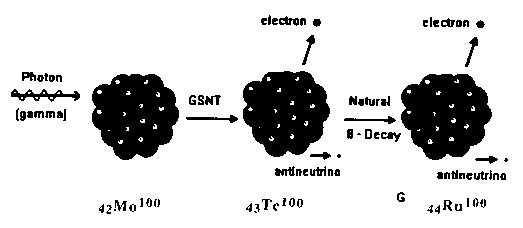
The main principle of Santilli's recycling of nuclear waste is the capability to stimulate the decay of the neutron via a photon with the particular resonating frequency (or energy) of 1.294 MeV, according to the reaction
(1) Photon-resonating + neutron -> proton + electron + antineutrino.
The above possibility has been confirmed by experiments conducted by Prof. N. Tsagas at the Nuclear Physics Laboratory of the University of Thrace, Xhanti, Greece, as well as by additional tests conducted in utmost secrecy owing to the organized opposition by politicians and academicians indicated in Section 1.
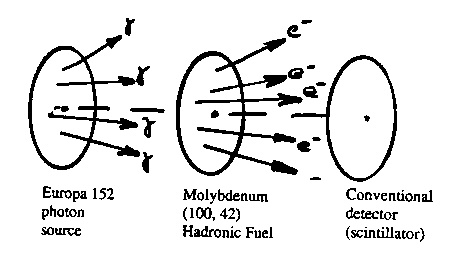
Santillis test (1) is quite simple and can be repeated at any physics laboratory. It consists in the use of a disk of Eu(52) or other sources of resonating photons with 1.294 MeV energy. This Europa disk is matched with a disk of an isotope admitting said stimulated decay of the neutron, most notable Zn(30, 70), Mo(42, 100), and various other isotopes (note that STABLE nuclei in general DO NOT admit Santillis stimulated decay, because numerous conservation and other laws have to be met, although the stimulated decay is admitted by all UNSTABLE nuclei - see the technical literature). The pair of Eu-Mo disks is then exposed to a detector capable of measuring the ENERGY of emitted electrons, such as a scintillator. This very simple experimental apparatus is then shielded from primary sources of radiations.
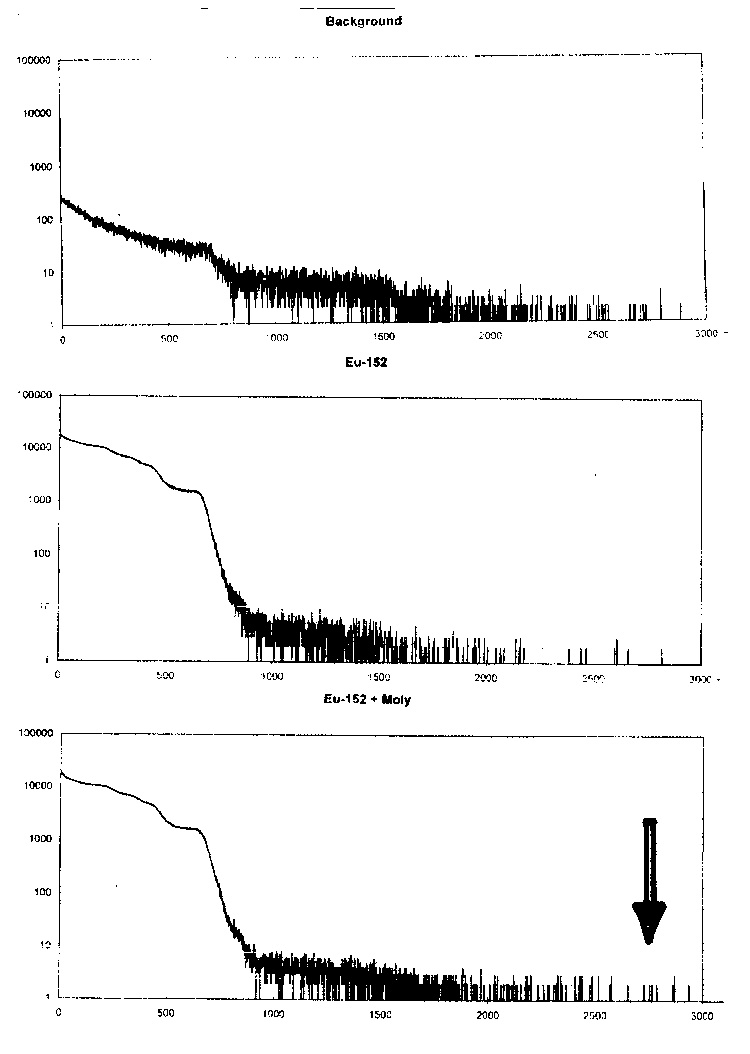
Three measurements of the energy of the emitted electrons are generally conducted: 1) Measurements of the background in the absence of the Europa and other sources; 2) Measurements in the presence of the Europa source alone; and 3) Measurements for the coupled Europa-Molybdenum pair. These comparative measurements have established the emission by the coupled Eu-Mo disks of electrons with well over 2 MeV energy which can ONLY be explained as originating from the stimulated decay of the peripheral neutron of the Molybdenum. In fact, electron originating from Compton scattering between the resonating photon and peripheral atomic electrons can at most have 1 MeV energy, as established by quantum electrodynamics. Electrons with energy above 2 MeV can, therefore, safely be assumed to originate from the decay of neutrons according to Santillis law (1).
Once law (1) is proved for natural light, stable elements such as Mo or Zn., its validity for unstable elements such as those of nuclear wast is so obvious to require no comment.
It should be indicated that the basic law (1) is indeed admitted by conventional quantum mechanics. However, its cross section is claimed to be very small for all energies, thus having no industrial or practical value. The reader should be aware of the politics here. Absolutely, positively, the cross section of reaction (1) has NOT been measured at ALL energies. It is CLAIMED so for scientific corruption. In reality,. reaction (1) has been only measured for a few energies and positively NOT for 1.294 MeV.
The generalized scattering theory underlying Santillis recycling of nuclear waste (which can be constructed via a nonunitary transform of the conventional scattering theory according to a method provided below) confirms that the cross section of reaction (1) is indeed very small at all energies, EXCEPT A LARGE RESONATING PEAK AT 1.294 MeV. The case is reminiscent of the large peak in the cross section which predicted in the 1960s the existence of the Omega-Minus particle.
3. MAIN LINES OF SANTILLI'S EQUIPMENT FOR THE RECYCLING OF NUCLEAR WASTE
Santillis recycling equipment is under international patent pending. Research on this equipment is permitted without any payment, and is actually solicited due to the societal importance of the issue, PROVIDED that such research is fully disclosed to Prof. Santilli and his paternity fully acknowledged.
Santillis recycling equipment is constituted by a coherent beam of the indicated resonating photons which can today be achieved via a small electron-positron synchrotron of about 2 meter in diameter, and other means. The exposure of UNSTABLE nuclei to such a beam implies the decay of a number of its peripheral neutrons, the disruption of the strong component of the nuclear force and other effects which cannot be disclose prior to the achievement of said patents.
Each of the above effect, alone, is sufficient to cause the instantaneous decay of unstable heavy nuclei which, when left isolated, would otherwise have a meanlife of tens of thousands of years. Said stimulated decay has to occur within a radiation absorbing environment such as the pool of current nuclear reactors. Once these heavy nuclei decay, their end products are stable and consists of light natural stable elements, including helium and hydrogen.
In more specific terms, Santilli's equipment consists of the following: 1) The source of coherent photons with said resonating frequency; 2) Pellets of radioactive waste as currently used in nuclear power plants placed directly in front of said source with the cylindrical symmetry axis along the direction of said beam; and 3) Automatic-electronic means moving the radioactive pellet under said beam in such a way to cover its entire sectional area via subsequent passes.
To under stand the process, one should remember that the nuclei of nuclear waste "are not" stable. On the contrary, said nuclei are "quite large and naturally unstable". Therefore, there must exist means for stimulating their decay. If Santilli's process does not work, there will be others. Thus, on scientific ground the only topic which is open for scientific debate is the appropriate MEANS to simulate the decay of radioactive waste. However, questioning a priori the EXISTENCE of such means is sheer scientific corruption.
4. HADRONIC MECHANICS
As indicated in Section 1, Santilli's process of stimulated decay "is not" compatible with quantum mechanics. Its quantitative study requires a covering of quantum mechanics which is known under the name of hadronic mechanics.
In a lifelong research Prof. Santilli has build a step-by-step structural generalization of Einstein's special relativity, the Minkowskian geometry, the Poincare' symmetry, the Hilbert spaces, and related quantum laws which have been specifically conceived for composite systems of constituents in "contact" with each others, such as hadrons, nuclei and stars.
These generalizations were called by Prof. Santilli "isotopic" because "axiom preserving". In fact, the generalizations here considered essentially consist in broader "realizations" of conventional abstract axioms.
The main feature of Santilli's theories is that of admitting an "invariant" representation of "contact" effect which do not admit any potential or a Hamiltonian, thus being dramatically outside the descriptive capabilities of quantum mechanics.
In the now historical original proposal made at Harvard University in 1978 under DOE support (see the Santillis three articles in the first volume of the Hadronic Journal, 1978) Santilli proposed that, since they cannot be represented with a hamiltonian by assumption, these nonpotential effects should be represented via a generalization of the trivial unit 1 of quantum mechanics into a nonsingular, positive-definite, integrodifferential n x n matrix or operator
(2) 1 -> E(t, r, psi, delta Psi, ...) = 1 / T)t, r, p, ....) > 0.
Jointly, Santilli suggested the necessary compatible generalization of the trivial associative product AxB of matrices as used in quantum mechanics into a generalized product A*B which is still associative (as a necessary condition for an isotopy),
(3) A x B -> A*B = A x T x B, T fixed,
Ax(BxC) -> A*(B*C) = (A*B)*C,
yet admits E, rather than 1, as the correct left and right unit
(4) E*A = E x T x A = (1/T) x T x A = A * E = A.
In subsequent decades, Santilli reconstructed the entire mathematics of quantum mechanics into a form admitting of E, rather than 1, as the correct unit, resulting in what are today called Santilli's isonumbers, isofields, isospaces, isominkowskian geometry, isopoincare' symmetry, isospecial relativity, etc.
Jointly, Santilli generalized the basic laws of quantum mechanics, by presenting since the original proposal of 1978 the isoheisenberg equations in their finite and infinitesimal form
(5) A(t) = [exp(ixHxTxt)] x A(0) x [exp(-ixtxTxH)],
i dA/dt = [A,* H] = A*H - H*T = A x T x H - H x T x A,
[r,* p] = ixE, [r,* r] = [p,* p] = 0.
In a paper of 1979, Santilli then proposed the corresponding compatible generalization of Schroedinger's equation which was subsequently also studied by various other physicists and mathematicians
(6) i D|psi> = H*|psi> = H x T x |psi> = E x |psi>
where D is partial derivative.
5. INVARIANCE AND UNIVERSALITY OF HADRONIC MECHANICS
The reason why Prof. Santilli suggested the representation of nonpotential-nonhamiltonian effects via a generalization of the unit is that the unit is the basic invariant of any theory, whether conventional or generalized. Therefore, at this writing HADRONIC MECHANICS IS THE ONLY GENERALIZATION OF QUANTUM MECHANICS WHICH IS INVARIANT. It is easy to prove that hadronic mechanics preserves the basic units of measurements, predicts the same numerical value for the same quantity under the same conditions at different times, admits a notion of hermiticity-observability which is invariant in time, and possesses ALL the same axiomatic properties of quantum mechanics. By comparison, it is easy to prove that other generalizations, such as those studies by E. Conte and various other studies, VIOLATE these basic conditions, thus having no known physical value of any type.
Similarly, it is easy to prove that HADRONIC MECHANICS IS "DIRECTLY UNIVERSAL", that is, including of ALL possible generalizations of quantum mechanics (universality), directly in the frame of the observer and without any need of coordinate transformations (direct universality). This is due to the fact that the most general conceivable,. nonlinear, nonlocal and nonpotential eigenvalue equation can always be written in Santilli's form H(r,p)xT(t, r, p, |>, ...), HxT =/ (HxT)^+.
6. SIMPLE CONSTRUCTION OF HADRONIC MECHANICS AND ITS INVARIANCE
Today, hadronic mechanics is taught at various first year graduate courses. Explicit and concrete applications of Santilli's hadronic mechanics can be easily constructed by everybody via a "nonunitary" transform of any given quantum model, i.e.:
(7) 1 -> UxU^+ = E = 1/T =/ 1,
n (number) -> UxnxU^+ = n x [UxU^+) = nxE (isonumber),
A x B -> Ux(AxB)xU^+ = (UxAxU^+)x(UxU^+)^{-1}x(UxBxU^ = A' x T x B' = A' * B',
[A, H] = AxH - HxA -> Ux(AxH - HxA)xU^+ = A'*H' - H' * A' = [A,*H],
H x |> -> Ux(Hx|>) = (UHU^+)x(UxU^+)^{-1}x(Ux|>) = H' x T x |>' = H' * |>, < | x |> x1 -> Ux(<|x|>x1)xU^+ = <|' x T x |>' x E,
etc. etc.
Note that the TOTALITY of quantum mechanics formalism must be lifted in Santillis form. This includes functions, such as exponential and logarithm, and transforms such as Fourier or Laplace, differential calculus, etc. If only SOME of the formalism of quantum mechanics is lifted while the other is not, one ends up in a minestrone with no known physical or mathematical meaning or value.
An additional nonunitary transform must also be reformulated in the new isomathematics, yielding the isounitary law
(8) W x W^+ = E =/ I,
W = W x T^{1/2},
W x W^+ = W * W^+ = W^+ * W = E.
The invariance of hadronic mechanics is then evident, e.g.,
(9) W*E*W^+ = E,
W*(A*B)*W^+ = A x T x B = A * B,
etc. etc.
Note the NUMERICAL INVARIANCE OF THE ISOUNIT E AND THE ISOTOPIC ELEMENT T IN THE PRODUCT. Invariant units of measurements, invariant numerical results, invariant hermiticity-observability can then be proved by a first year graduate student in physics.
By comparison, it is easy to prove that any other nonunitary theory, when formulated on CONVENTIONAL MATHEMATICS (THAT IS, EXPRESSED ON CONVENTIONAL SPACES OVER CONVENTIONAL FIELDS, ETC.) IS AFFLICTED BY CATASTROPHIC INCONSISTENCIES. Consider one such nonunitary theory, e.g., that by E. Conte. It is then easy to see then following catastrophic inconsistencies:
1) The basic units of measurements, say, m, are not preserved by the theory, trivially because its time evolution is nonunitary,
(1) m -> m = UxmxU^+ =/ m.
The theory then has no known application to experiments.
2) Quantities which are hermitean at the initial time, are no longer hermiteanm at subsequent times because the Hermiticity law now becomes
(11) H^+ = T^{-1}xH^+xT =/ H^+
which is different than H^+ because H and T do not necessarily commute. This implies that Contes theory has no known observables of any type.
3) The theory does not possess invariant numerical predictions. This occurrence can be easily proved for the simple case
(12) UxU^+ (t = 0) =- 1, and UxU^+( t = 15 sec.) = 5.
Suppose that such a theory predicts, say,. the value 5 eV at the time t = 0,
(13) H x |> = 5 eV x |>.
Then, the same theory at time t = 15 sec. predicts the following DIFFERENT value
(14) (UxHxU+^) x (UxU^+)^{-1}) x (Ux|>) = H x (1/E) x |> = 5 eV x (Ux|}>) = 5 eV |>,
H x |> = 5 eV x (UxU^+) x |> = 25 eV x |>
thus having no known value of any type.
7. APPLICATION OF HADRONIC MECHANICS TO RECYCLING OF NUCLEAR WASTE
Relativistic quantum mechanics and Einstein's special relativity have indeed permitted a good approximation of nuclear structures, as proved by the construction of nuclear power plants themselves which are based on these theories. However, the claim that these theories provide the final and ultimate, "exact" representation of nuclear structures is vulgar scientific corruption perpetrated for personal gains.
Among a river of evidence supporting the impossibility for Einstein's doctrines to be "exactly" valid for nuclear structure discussed in the literature of the 20-th century (but ignored by academia) is the following argument repeatedly presented by Santilli. A NECESSARY condition for the EXACT validity of the Poincare' symmetry is that the systems represented have a KEPLERIAN STRUCTURE, namely, THE SYSTEMS ADMIT THE HEAVIEST PARTICLE AT THE CENTER and all remaining particles are in orbit around such a Keplerian center WITHOUT COLLISIONS. This is the case for all bound systems at large mutual; distances, such as the ATOMIC or PLANETARY structures. In these cases we only have action-at-a-distance, potential force in which case Santilli's theory recover all conventional. doctrines identically with E = 1.
Consider now nuclei. It is evident to all that NUCLEI DO NOT HAVE NUCLEI, namely, NUCLEI ARE NOT KAPLERIAN SYSTEMS. In fact, an arbitrary individual constituent (such as one proton or one neutron) can be the center of nuclei. Under this incontrovertible evidence a first year graduate student can prove the following:
THEOREM 1: EINSTEINIAN DOCTRINES AND RELATIVISTIC QUANTUM MECHANICS "CANNOT" BE EXACT FOR NUCLEAR STRUCTURE BECAUSE NUCLEI DO NOT ADMIT KEPLERIAN NUCLEI. PERIOD.
This proves that, again, Einsteinian doctrines can indeed provide a first approximation of nuclear structures, but the claims that they are "exactly" valid in a final form is vulgar corruption. We may debate which GENERALIZATION of Einsteinian doctrines is applicable to nuclei, but NOT its need.
WEBMASTER, PLEASE PUT SCAN # 3.
Prof. Santilli isospecial relativity, isopoincare' symmetry and relativistic hadronic mechanics have been constructed precisely to represent bound states of particles under CONTACT NONPOTENTIAL INTERACTIONS characterized by the isounit E or, equivalently, the isotopic element T in the isoscroedinger's equation HxTx|> = Ex|>. Therefore, a first year graduate student can prove the following
THEOREM 2: THE SYSTEMS REPRESENTED BY SANTILLI'S ISOSPECIAL RELATIVITY AND RELATIVISTIC HADRONIC MECHANICS "CANNOT" BE KEPLERIAN, BECAUSE THE CONSTITUENTS ARE IN CONTACT WITH EACH OTHER BY CONSTRUCTION.
Once these basic notions are technically understood, it is easy to see the basic mechanisms of Santilli's stimulated decay of radiative nuclei. This decay has nothing to do with the hamiltonian H = p^2/2m + V(r) in the basic equations because this hamiltonian can ONLY represent action-at-a-distance POTENTIAl interactions for which indeed no change of the lifetime of nuclei is possible. Santillis mechanisms of stimulated decay solely act on the NONPOTENTIAL EFFECTS represented by E or T. That is the BIG difference and novelty.
It happens that these nonpotential effects are fundamental to achieve an attraction among constituents in contact with each other, as proved at the hadronic, nuclear and molecular levels (see the technical literature for this crucial point). As a result, mechanisms which resonate NONPOTENTIAL contributions disrupt the entire nuclear structure, let alone the structure of the individual neutrons. Instantaneous decay of unstable nuclei is then consequential. A graduate student can then prove the following:
THEOREM 3: RESONATING MECHANISMS ON THE STRONG NUCLEAR FORCE OF RADIOACTIVE NUCLEI CAUSE THEIR DECAY.
In fact, said resonating mechanisms imply that, locally, Santillis isounit recovers the conventional value, E -> 1, in which case, particles are no longer in CONTACT, thus implying the separation of the system.
8. CONCLUSION
While in the past century Einsteinian doctrines and quantum mechanics did permit historical achievements, today, the same doctrines are the real enemy of society because the surpassing of said doctrines is now mandatory to resolve large societal problems, such as the recycling of nuclear waste or the achievement of new clean energies and fuels.
As a consequence, any scientist or individual who supports the final character of Einsteinian doctrines and quantum mechanics for the representation of nature is a real enemy of society.
9. REFERENCES
SUMMARY OF CURRICULUM VITAE OF PROF. SANTILLI
(http://www.magnegas.com/ir00021.htm)
DENUNCIATION OF POLITICAL CORRUPTION
R. M. Santilli, Politics of Nuclear Waste, Sarasota Eco Report, Vol. 6, # 12, Dec. 1996, Pages 1 and 1.6.
Denunciations of scientific corruption
R. M. Santilli, Ethical Probe of Einstein Followers in the USA: An Insiders View, Alpha Publishing, Newtonville, MA, 1984
R. M. Santilli, Documentation of Ethical Probe, Volumes I, II, and III, Alpha Publishing, Newtoinville, MA, 1985.
TECHNICAL REFERENCES
Santillis original refereed publication on the recycling of nuclear waste under patent pending:
R. M. Santilli, in Large Scale Collective Motion of Atomic Nuclei, G. Giardina et al., Editors, World Scientific (1997)
Patents on other methods which could be added to Santillis recycling
T. B. Shafer et al., U.S. Patent 4,338,215 (1982). R. Mariot et al., U.S. Patent 4,721,596 (1988).
The first known reference on (p, q)-deformations of Lies theory and Heisenbergs equation sin the literature (which dates to 1967, but it is not quoted in the river of papers in the field)
R. M. Santilli, Nuovo Cimento 51, 570, 1967.
Mathematical Foundations of Santillis recycling.
P. Vetro, Editor, Rendiconti Circolo Matematico Palermo, Suppl. Vol. 42, 1996, special issue entirely dedicated to Santillis iso-, geno- and hyper mathematics and their isoduals
Main references on hadronic mechanics
R. M. Santilli, Found. Phys. 27, 625, 1997; and 27, 1159 1997.
Main references on Santillis isospecial relativity
R. M. Santilli, Nuovo Cimento Lettere 37, 545, 1983; J/ Moscow Phys. Soc. 3, 255, 199; Intern. J. Modern Phys. D 7, 351, 1998.R. M. Santilli, Acta Appl. Math. 50, 177, 1998.
Grand unification including gravitation permitted by isomathematics admitting all recycling of Santillis type as a particular case:
R. M. Santilli, Found. Phys. Letters 10, 307, 1997, and Proceedings of the VIII M. Grossmann Meeting on Gravitation and Cosmology, Jerusalem, 1997.
Main references on hadronic superconductivity
A. O. Animalu, Hadronic J. Vol. 17,m 321, 189. A. O., E. Animalu and R. M. Santilli, Intern. J. Quantum Chemistry 29, 175, 1995.
Main references on hadronic chemistry and its new model of molecular structure:
R. M. Santilli and D. D. Shillady, Intern. J. Hydrogen Energy 24, 943, 1999; and 25, 173, 2000. R. M. Santilli, Foundations of Hadronic Chemistry and its Applications to New Clean Energies and Fuels, in press at a leading publisher.
Main references on Santillis isodual theory of antimatter
R. M. Santilli, Intern. J. Modern Phys. A 14, 2205, 1999, and Hyperfine Inter. 109, 63, 1997.
Systematic review of the new structure models of hadrons, nuclei and molecules permitted by hadronic mechanics and their vast experimental verifications
R. M. Santilli, J. New Energy 4, issue no. 1, 1999.
Main reference on the catastrophic mathematical and physical inconsistencies of nonunitary theories formulated over conventional mathematics
[13] R. M. Santilli, Intern. J. Modern Phys. A 14, 3157, 1999.
Some mathematical studies in the field by other authors are given by
J. V. Kadeisvili, Math. Methods in Applied Sciences 19, 362 [1996]. Gr. T. Tsagas and D. S. Sourlas, Algebras, Groups and Geometries 12, 1 and 67 [1995]. D. Rapoport-Campodonico, Algebras, Groups and Geometries 8, 1 [1991]. R. Aslaner and S. Keles, Algebras, Groups and Geometries 14 211 [1997]. S. Vacaru, Algebras, Groups and Geometries 14, 225 [1997]. E. B. Lin, Hadronic J. 11, 81 [1988] . Gr. Tsagas, Algebras, Groups and Geometries 13, 129 [1996].
Same physical studies by other authors are given by:
S. L. Adler, Phys. Rev. 17, 3212 [1978] . S. Okubo, Hadronic J. 5, 1667 [1982] . R. Mignani, Hadronic J. 5, 1120 [1982]; Nuovo Cimento Lett. 39, 413 [1984]. A. Jannussis, R. Mignani and D. Skaltsas Physica A 187, 575 [1992]. C. N. Ktorides, H. C. Myung and R. M. Santilli, Phys. Rev. D 22, 892 [1980]. T. Gill, J. Lindesay and W. W. Zachary, Hadronic J. 17, 449 [1994]. E. B. Lin, Hadronic J. 11, 81 [1988]. A. J. Kalnay, Hadronic J. 6, 1 [1983]. A. Kalnay and R. M. Santilli, Hadronic J. 6, 1798 [1983]. J. Fronteau, A. Tellez Arenas and R. M. Santilli, Hadronic J. 3, 130 [1979]. R. Mignani, H. C. Myung and R. M. Santilli, Hadronic J. 6, 1878 [1983]. A. O. E. Animalu and R. M. Santilli, in Hadronic Mechanics and Nonpotential Interactions [Nova Science, New York, 1990]. R. Mignani, Nuovo Cimento 43, 355 [1985]. M. Gasperini, Hadronic J. 7, 971 [1984]. A. Jannussis, M. Mijatovic and B. Veljanowski, Physics Essays 4, 202 [1991]. M. Nishioka, Nuovo Cimento A 82, 351 [1984]. A. Jannussis, D. Brodimas and R. Mignani, J. Phys. A 24, L775 [1991]. G. Eder, Hadronic J. 4, 634 [1981] and 5, 750 [1982]. J. D. Constantoupoulos and C. N. Ktorides, J. Phys. A 17, L29 [1984]. A. Jannussis, G. Brodimas, and R. Mignani, J. Phys. A 24} L775 [1991]. R. Mignani, Physics Essays 5, 531 [1992].
Hadronic mechanics is also treated by some 15 post Ph.D. monographs and about 50 volumes of Proceedings of international conferences help in the USA, Europe and Asia which cannot be listed here for brevity 9see the references of the above quoted primary literature).
